Wednesday, March 3, 2010

Untitled

The New Navarre Fishing Pier is Nearing Completion

The nice thing about my office being on the beach is I can take a break and see what is going on. Today I took my camera and took a picture of The new pier.

It's Tuesday and I have already had a busy week I worked with really nice family we found them a bank owned house which was price almost 33% less than the comperable homes. The only thing that was missing was the appliances. It has Granite counter tops security system, huge rooms, fireplace downstairs master suite. I also leased a commercial building and trying to find a short term rental for a new customer.

It took us 3 months to find this Home. We had just made an offer on a short sale and the owner turned us down not even the bank. I had done a CMA and our offer was in line with the previous sale but the owner thought it was worth more than we offered. This family will most likely have built in equity a rarity in today's market. This house was price so low you could not afford to build it for what they where asking.

Some say it is a bad Real Estate market. I say it is nether good nor bad it is what it is. This buyer was smarter he made calculation of what he could afford and we look at properties in his price range and made offers, got turned down but did not get upset. He was like the the barber with a long line on Saturday mornings. "Next"

The Fishing Pier will be open in two months. Fishing has some similarities to home shopping it take preparation, timing, skill and opportunities. If you caught fish every time you went, they would call it catching not fishing.

links to properties near fishing pier

Navarre median sales prices

Posted via email from uberrealty's posterous

Tuesday, March 2, 2010

USHUD.com, Heavy Hammer Inc. Predict Foreclosure Rates Doubling in 2010

USHUD.com, Heavy Hammer Inc. Predict Foreclosure Rates Doubling in 2010

ANNAPOLIS, MD -- Foreclosure experts at www.USHUD.com and Heavy Hammer Inc. see a confluence of factors driven by financial industry practices and changing government policies and regulations exacerbating an already devastated housing market in 2010. The resulting effect will be a doubling of real estate foreclosure rates in this year.

The first and most obvious factor is the unemployment rate that continues to languish in the 10 percent range nationally, and often much higher regionally. Similar unemployment rates have historically affected 20 to 30 percent of home owners' ability to make their scheduled mortgage payments.

The second factor is the significant constriction of lending due to tightening mortgage requirements, according to www.USHUD.com CEO Michael Urbanski.

"The mortgage pendulum is now swinging too far to the opposite spectrum of what we saw at the height of the real estate market," Urbanski said. "Lending institutions are creating hurdles so high that it will put qualified homebuyers back six to 12 months in the buying cycle."

Urbanski also reports struggling homeowners who seek loan modifications are increasingly experiencing difficulties qualifying for programs that could stave off foreclosure. "The current qualifications are so absurd they require the home owner to prove that they do not need a modification in order to get one," said Urbanski. Even the administration has announced new, stricter documentation requirements beginning June 1 for its Making Home Affordable program, which has seen underwhelming results since its inception last March.

Citing a National Association of Realtors study that finds the average U.S. home depreciated 12 percent year-over-year from 2008 through 2009, Urbanski says selling will become an impossible proposition for a growing number of underwater homeowners.

"Watch the horizon," said Urbanski. "Left unchecked, the perfect storm may be only one more bad policy away."

Headquartered in Annapolis, Heavy Hammer Inc., is an online networking and consulting company advocating for American homebuyers, connecting them with trusted experts and valuable resources. Driving one of the most widely used suites of foreclosure Web sites, Heavy Hammer delivers free, all-inclusive lists of foreclosure properties to more than 500,000 homebuyers monthly. In business since 1998, Heavy Hammer has focused on geographically-based ad serving technology and processes allowing thousands of professionals to target specific locations, connecting directly with consumers in specific locations. Starting with www.USHUD.com, this group of sites now includes more than 30 state- and region-specific sites.


Posted via email from uberrealty's posterous

Info on falling home prices

Destin, FL - March 1, 2010 - (RealEstateRama) — Severe headwinds, including high unemployment, rising foreclosures, a tight mortgage arket and expiring government programs are forecast to send home prices

in the majority of U.S. markets lower in 2010, according to the national U.S. Housing Predictor forecast.

The average price of a home is forecast to deflate 8.5% for the year. The first time home buyers’ tax incentive and an expansion of the government program to move-up buyers will usher in a higher volume of sales, but little real pricing recovery is projected for the year. The excess inventory of homes for sale and a shadow inventory of at least 2.8-million housing units will pressure markets.

The U.S. home price assessment was determined after a lengthy review of data gathered in the majority of housing markets. Failures by Congress and the White House to proactively work to rein in the excesses on Wall Street and a tight mortgage market make it unlikely for markets to unwind from the collapse in housing, and may prolong the downturn a number of years.

Rising foreclosures are damaging housing values in the majority of the country even as some markets see slight increases in home prices, but much of the housing inflation is due to government incentives and government purchasing of mortgage-backed securities. When government programs are halted, Housing Predictor analysts project housing markets will turn sluggish.

Consumers, business owners, retail companies, bankers, mortgage companies and real estate

firms consult Housing Predictor forecasts. Housing Predictor provides free real estate forecasts for markets in all 50 states, real estate news and analysis on the housing market at http://www.housingpredictor.com

Posted via email from uberrealty's posterous

Monday, March 1, 2010

New Homes for sale in Navarre

New Homes for sale in Navarre.
The following are the links to the selected listings.

532761 - Details: 2209 LAS VEGAS TRAIL, NAVARRE, FL - $189,900
532748 - Details: 1962 MOORING DR, NAVARRE, FL - $219,500
532762 - Details: 9939 PARKER LAKE CIRCLE, NAVARRE, FL - $219,900
532755 - Details: 7933 SKYVIEW BLVD, NAVARRE, FL - $179,900
532736 - Details: 6704 SEA GATE DR, NAVARRE, FL - $359,900
532829 - Details: 2127 CHESHIRE CT, NAVARRE, FL - $290,000
532812 - Details: 6471 SAILPORT COVE, GULF BREEZE, FL - $169,950
532787 - Details: 7941 LOLA CIR, NAVARRE, FL - $179,900
532763 - Details: 7460 SOUNDSHORE DRIVE, NAVARRE, FL - $269,900
532746 - Details: 4817 KITTY HAWK CIR, GULF BREEZE, FL - $219,900
532830 - Details: 6396 OLD HARBOR CT, GULF BREEZE, FL - $275,000

Or Click Here to go view all listings at once.

REALTORS: REAL-Service REAL-Expertise.
You can also visit http://www.uberrealty.com to perform your own property search.


Jim Whatley

jim@UberRealty.com

850 499 2940 mobile

Posted via email from uberrealty's posterous

New Homes for sale in Navarre

New Homes for sale in Navarre

532761 DSF 1102 A 2209 LAS VEGAS TRAIL 1,783 3 2/ 2005 $106.50 $189,900 EAM5
532748 DSF 1102 A 1962 MOORING DR 1,975 3 2/1 2010 $111.13 $219,500 NPUL
532762 DSF 1102 A 9939 PARKER LAKE CIRCLE 2,016 3 2/ 2005 $109.07 $219,900 EAM5
532829 DSF 1102 A 2127 CHESHIRE CT 3,000 4 3/ 2003 $96.66 $290,000 EMNG
532755 DSF 1104 A 7933 SKYVIEW BLVD 1,728 3 2/0 1995 $104.10 $179,900 NHPR
532787 DSF 1104 A 7941 LOLA CIR 1,674 3 2/0 1999 $107.47 $179,900 NIVR
532763 DSF 1104 A 7460 SOUNDSHORE DRIVE 2,781 3 2/ 2002 $97.05 $269,900 ESHG
532736 DSF 1104 A 6704 SEA GATE DR 2,975 4 2/1 1998 $120.97 $359,900 NCBU2
532746 DSF 1106 A 4817 KITTY HAWK CIR 2,285 4 2/ 1994 $96.23 $219,900 NCBU2
532830 DSF 1106 A 6396 OLD HARBOR CT 2,424 4 2/0 2007 $113.44 $275,000 NHPR
532812 DSF 1104 W 6471 SAILPORT COVE 1,800 3 2/ 1999 $94.41 $169,950 NIVR

Posted via email from uberrealty's posterous

Saturday, February 27, 2010

New homes for sale in Navarre

No-Risk Home Selling

The following are the links to the selected listings.

532332 - Details: 8353 RANDALL DR, NAVARRE, FL - $87,000
532327 - Details: 7891 SLEEPY BAY BLVD, NAVARRE, FL - $153,000
532364 - Details: 8142 MENORCA ST, NAVARRE, FL - $159,000
532342 - Details: 2720 BAY WATCH LN, NAVARRE, FL - $165,900
532329 - Details: 6459 HERONWALK DR, GULF BREEZE, FL - $146,900
532444 - Details: 2165 LAS VEGAS TRAIL, NAVARRE, FL - $135,000
532417 - Details: 6388 OLD HARBOR CT, GULF BREEZE, FL - $229,900
532448 - Details: 5168 POINT SHORES LN, GULF BREEZE, FL - $679,000
532582 - Details: 9162 EAGLE NEST DR, NAVARRE, FL - $89,900
532501 - Details: 8216 COSICA BLVD, NAVARRE, FL - $214,900
532387 - Details: 9348 VANDIVERE DR, NAVARRE, FL - $229,000
532562 - Details: 1985 RUE LA FONTAINE, NAVARRE, FL - $359,000
532577 - Details: 1794 THRESHER DR, NAVARRE, FL - $264,500
532477 - Details: 1727 TURKEY OAK DR, NAVARRE, FL - $699,900
532579 - Details: 6809 MARLIN ST, NAVARRE, FL - $209,900
532631 - Details: 9517 POUDER LANE, NAVARRE, FL - $237,700
532642 - Details: 9536 BONE BLUFF DR, NAVARRE, FL - $399,000
532602 - Details: 7352 MULBERRY LN, NAVARRE, FL - $374,750
532600 - Details: 7586 PEPPERWOOD ST., NAVARRE, FL - $209,900
532608 - Details: 7457 FRANKFORT ST, NAVARRE, FL - $249,900
532616 - Details: 5084 MANDAVILLA BLVD, GULF BREEZE, FL - $199,650
532640 - Details: 1950 ELODIE LANE, GULF BREEZE, FL - $205,000
532638 - Details: 1648 WOODLAWN WAY, GULF BREEZE, FL - $274,900
532648 - Details: 1981 PENTAGON ST, NAVARRE, FL - $49,000
532658 - Details: 6732 LIBERTY ST, NAVARRE, FL - $255,000
532675 - Details: 2528 HILTON DR, NAVARRE, FL - $139,000
532686 - Details: 308 CORDOBA ST, GULF BREEZE, FL - $199,900

Or Click Here to go view all listings at once.

If your email program doesn't support an HTML url, then copy and paste the following
address to your browser's address box. Make sure you copy and paste the
entire link; it may appear on multiple lines.

http://ecarmls.com/EmeraldReports/ListitLib/show_report.aspx?ID=2821887371


REALTORS: REAL-Service REAL-Expertise.
You can also visit http://www.uberrealty.com to perform your own property search.


Jim Whatley

jim@UberRealty.com

850 499 2940 mobile

Posted via email from uberrealty's posterous

Friday, February 26, 2010

Are You Waiting For Lightning To Strike?

Are You Waiting For Lightning To Strike?

If your home is over priced You are. Your are wondering what is he talking about? If you have over priced your home there a small chance that someone could come along and pay you what you are asking. They will have to pay all cash or the difference to make the loan to value at least 80 to 90%. Houses do get struck by lighting so keep hope alive. I have some lottery tickets that I only use once.

Posted via email from uberrealty's posterous

Weak Data Moves Mortgage Rates Lower

Mortgage Time
Mortgage Market News for the week ending February 26, 2010
Weak Data Moves Mortgage Rates Lower

After several weeks of focus on Fed actions and events in foreign markets, domestic economic data was the primary influence on mortgage markets this week. Weaker than expected results from the data helped mortgage rates, which ended the week lower.

While it is rarely a big market mover, this week's Consumer Confidence report shocked investors. The index declined to 46.0, far below the consensus forecast of 55.0, and the lowest level in nine months. Consumers are clearly worried about the labor market, and an increase in Jobless Claims in recent weeks has amplified the issue. The decline in confidence has potentially negative consequences for the economy. Consumer spending accounts for about 70% of economic activity, and this data raises concerns about the level of future spending. Also, home sales suffer during periods of low consumer confidence, and the housing data released this week reflected consumer insecurity. Of course, slower economic growth is favorable for mortgage rates, which fell after the report came out.

In contrast to the weakness seen in many of the consumer-driven economic reports, the manufacturing sector has been demonstrating strong performance in recent months. Fourth quarter Gross Domestic Product (GDP), the broadest measure of economic activity, rose at a brisk 5.9% annual rate, largely due to a pickup in manufacturing. The added boost from manufacturing may be temporary, however. During the financial crisis, companies drew down inventories as much as possible to conserve capital. As the economy has shown improvement, companies have been increasing inventories closer to pre-crisis levels. When the inventory rebuilding is complete, manufacturing is expected to return to more normal levels.


    Also Notable:
  • Weekly Jobless Claims unexpectedly jumped to a three-month high
  • January New Home Sales dropped 11% from December to a record low
  • Bernanke said he doesn't anticipate any MBS sales by the Fed in the near term
  • The Fed purchased $11 billion in agency MBS, with about $44 billion more to go

Average 30 yr fixed rate:
Last week: +0.10%
This week: -0.10%
Stocks (weekly):
Dow: 10,350 -50
NASDAQ: 2,240 -10
  

Week Ahead

The biggest economic event next week will be the important Employment report on Friday. As usual, this data on the number of jobs, the Unemployment Rate, and wage inflation will be the most highly anticipated economic data of the month. Early estimates are for a decrease of about -20K jobs in February. Before the employment data, Personal Income and the ISM manufacturing index will be released on Monday. ISM Services and the Fed's Beige Book will be released on Wednesday. Pending Home Sales, a leading indicator for the housing market, will come out on Thursday. Productivity, Construction Spending and Factory Orders will round out the schedule. In addition, the Treasury will announce the size of upcoming auctions on Thursday.

To learn more about news impacting interest rates and mortgage markets, go to www.mbsquoteline.com
To learn more about the newsletter, please call 800-627-1077
All material Copyright © Ress No. 1, LTD and may not be reproduced without permission.

6cb2fbce8d
6cb2fbce8d

Regards,
Jim Whatley
UberRealty.com
850.499.2940

Posted via email from uberrealty's posterous

Thursday, February 25, 2010

It ain't over, till it is over.

According to Deutsche bank predicts that 50% of all mortgages will be underwater by 2011. Yes there was a small up tick of prices in November. Can anyone say $8000 check from Government.

Is now a good time to buy Yes and no but mostly Know. Know what your situation is, can you afford to purchase a home. Is it in an area where there will be demand now and in the future. Is it good repair. Good schools and generally location, location and location. Make sure look at what will happen in the neighborhood in the next couple of years. Where all the homes built and bought between 2005-2007 if so, most will be underwater on there mortgage. Will there be walk aways? Foreclosures short sales?

Now Might be the best time to buy in recent history but know a good Realtor and know what you are buying. Know the neighborhood You arebuying into because you are buying a neighborhood also. A 200,000 home in 100,000 neighborhood is not a good buy even at 150,000.


Jim Whatley

Broker www.UberRealty.com


Posted via email from uberrealty's posterous

Wednesday, February 24, 2010

Mint Map: Where the Jobs Will Be

<embed width="500" height="350" src="http://www.mint.com/blog/wp-content/uploads/2010/02/MNT-CITIES-WITH-JOBS-R4.swf" type="application/x-shockwave-flash"/><br />Budgeting – Mint.com

With the current unemployment rate at 10.6 percent and soaring even higher, you might have to seriously consider relocating in order to find work. You know what the say about the grass being greener? Well, our latest map shows that not all cities are faring equally in our current economic climate and in fact some are actually growing. Take a look to find out which cities are projected to have the greatest number of new jobs created, as well as those with the fastest rate of job growth over the next 20 years.
Regards,
Jim Whatley
UberRealty.com
850.499.2940

Posted via email from uberrealty's posterous

Tuesday, February 23, 2010

When a good deal isn't

When a good deal isn't

Just because a house is less expensive than it was last year does not mean it is a good deal. Run the number will you be house poor. How long do you think you will live there? Do you know the hidden cost of owning a home? Really do your homework before you start shopping for a home. FInd a broker or agent that has a long range view not just that is a lower price than last year.  


Regards,
Jim Whatley
www.UberRealty.com
850.499.2940

Posted via email from uberrealty's posterous

Must read if you want to sell you home.

Must read if you want to sell you home.


http://www.nytimes.com/2010/02/21/realestate/21wczo.html?source=patrick.net

6cb2fbce8d
6cb2fbce8d

Regards,
Jim Whatley
UberRealty.com
850.499.2940

Posted via email from uberrealty's posterous

Monday, February 22, 2010

Are You Waiting For Lightning To Strike?

Are You Waiting For Lightning To Strike?

If your home is over priced You are. Your are wondering what is he talking about? If you have over priced your home there a small chance that someone could come along and pay you what you are asking. They will have to pay all cash or the difference to make the loan to value at least 80 to 90%. Houses do get struck by lighting so keep hope alive. I have some lottery tickets that I only use once.

Posted via email from uberrealty's posterous

Thursday, February 18, 2010

It seemed like a good idea at the Time.


It seemed like a good idea at the Time.

This house is over by my Mothers house and she had to see it so one day my wife, mom and dad went to check it out. The guy who built this house was building his dream house. He put everything he could dream of in this house but went broke along the way. The reason this house will not sell is that he built it on a swamp. It is listing like a boat. I took out my Ipod Touch with the level app. It is off by 7% that might not sound like much but when it is a house it's like walking up hill, down hill or on the side of a hill the whole time. It cost over a million to build this thing and now it is in the MLS for less than 500k. Attached is a estimate to right the house 375k. I always say there is a buyer for every house. This could be the exception to prove the rule.  I have a link to some pictures check it out. If you want to see it let me know I would like to look at it again.


http://uberrealty.com/SearchResultsGM.aspx?freetext=24+meigs&brokerFeed=FLIDX

Posted via email from uberrealty's posterous

Wednesday, February 17, 2010

Ronald McDonald arrested for threatening a witness


Ronald McDonald arrested for threatening a witness


Daily News

CRESTVIEW - A 49-year-old man was arrested Feb. 4 for intimidating or threatening a witness, victim or informant, according to an Okaloosa County Sheriff's Office report.

Ronald McDonald was charged with two counts of obstructing justice after an incident on Oct. 29, the report said. He was arrested Feb. 4 and is scheduled to appear in court March 16.


Posted via email from uberrealty's posterous

Friday, February 12, 2010

the Great Wall of China is real Chinese takeout.

Guess what the new trend in new homes will be from the east. It will impact a lot of the newer homes and one that will most likely be in a short sale. It is  great Chinese dry wall. In some cases the whole house dry wall will need to be replaced. So what else does that mean? Law suits and complicated sales a new disclosure form and a new label for homes

How about “Chinese takeout.” does that come with soup and and eggroll. I know for sure it will cause heartburn.


the listing which started this blog
http://www.uberrealty.com/mls-531832-feed-flidx-address-302-shield-drive-crestview-fl-32539-$100,000-propIndex-0.aspx

Here are the homes being sold in the neighborhood

http://uberrealty.com/SearchResultsGM.aspx?freetext=Iron+gate&brokerFeed=FLIDX

Posted via email from uberrealty's posterous

Wednesday, February 10, 2010

Mortgage Investors Push for Principal Writedowns

Mortgage Investors Push for Principal Writedowns


Mortgage principal – to cut or not to cut – has grabbed a fair share of the media spotlight in recent weeks. A number of experts and analysts are plugging principal

reduction as a practicable means of ensuring payments keep coming in and homeowners don’t redefault on their modified loan.

A new study by Santa Clara University’s Leavey School of Business puts the numbers and calculations to the test, and the report’s author, Sanjiv R. Das, concluded that “lenders should forgive, not forsake, mortgages.”

Das’ paper states that trimming the principal is “not a favored recipe” among lenders and is often prohibited by agreements with investors. But one such group of prominent mortgage loan stakeholders isn’t standing in the way of principal forgiveness – in fact, they are lobbying Congress to enact legislation to address the problem of underwater mortgages by reducing the homeowner’s debt.

The Mortgage Investors Coalition represents holders of some $100 billion in mortgage securities and includes such name as Fortress Investment Group, ICP Capital, and HBK Capital Management. According to a report from Reuters, the organization pitched a proposal to House Financial Services Committee Chairman Barney Frank last week that focuses on principal writedowns for second liens.

During the housing boom, when it seemed property values could only go up, homeowners enhanced their wealth (but increased their debt) by taking out secondary home equity lines of credit. These second liens are now impeding some modifications, and according to research from Amherst Securities cited by Reuters, they are attached to more than half the mortgages in private mortgage-backed securities (MBS).

Micah Green, an attorney representing the Mortgage Investors Coalition, told the news agency that the investors are prepared to consider a principal reduction plan where losses are shared, rather than completely wiped out in exchange for an incentive payment, as the Treasury has outlined in its second lien program under the Making Home Affordable plan.

As Reuters explained, under the coalition plan, investors would forgive principal to 96.5 percent of homes’ value, clearing a path for borrowers to refinance into a federally backed mortgage.

Green, of the Washington law firm Patton Boggs LLP, told “Reuters that he believed this softened position on second liens could help break the impasse keeping large servicers from forgiving principal. He called the proposal “a natural evolution” for the government’s Home Affordable Modification Program (HAMP). Investors want it because they, like homeowners, are in bad loans, Green explained to the news service.

Recent analysis from the credit ratings agency DBRS shows that mortgage restructurings employing principal writedowns increased to 13 percent of all modifications in the third quarter of last year, up from 10 percent in the second quarter and 3 percent in the first.

But while speculation has grown that the administration may be preparing to make principal reduction a centerpiece of HAMP, officials have repeatedly stated that no such alterations to the program are in play.

“There is a growing sense of concern among policymakers that the lack of homeowner equity is really getting in the way of providing a solution to homeowners,” Green told Reuters.


Regards,
Jim Whatley
UberRealty.com
850.499.2940

Über
    Realty
Über service - less cost
(uber= superior, awesome)

Posted via email from uberrealty's posterous

Zillow: Signs of a 'double dip'

Zillow: Signs of a 'double dip'

Home values fall in the fourth quarter of 2009

Inman News

For the 12th straight quarter, home values declined year-over-year, according to property search and valuation site Zillow. The site released its fourth-quarter 2009 real estate market report Wednesday.

Home values declined 5 percent between fourth-quarter 2008 and fourth-quarter 2009, and 0.5 percent from the third quarter of 2009 to the fourth, to a median valuation of $186,200. More than 1 in 5 mortgaged single-family homes, 21 percent, were "underwater," meaning the owners owed more on the house that it was worth. That negative equity rate remained virtually unchanged quarter-over-quarter.

In a sign of an impending "double dip" in the housing market, 20 percent (29 out of 143) of metropolitan areas Zillow studied had flat or decreasing home values after at least five straight months of increases during 2009. Zillow defined a market experiencing a double dip as one that saw decreasing monthly home values of at least 1 percent for at least five consecutive months, followed by a similar increase in monthly home values, followed by a similar decrease.

Markets that already fit this definition are Augusta, Ga., Greeley, Ohio, Harrisburg, Pa., Lancaster, Pa., and Oklahoma City, Okla. Home values in these cities range from $110,000 in Augusta to $180,900 in Lancaster.

Major metro areas in danger of a double dip include Atlanta, Ga., with a median home value of $153,100; Boston, Mass., with a median value of $321,000; Denver, Colo., at $211,500; San Diego, Calif., at $354,900; and San Jose, Calif., at $562,600.

"What we saw in mid-2009 was a brief respite from a larger market correction that has not yet run its course. The good news is that, for those markets that will see a double dip in home values before reaching a definitive bottom, this second dip will not be a return to the magnitude of depreciation seen earlier, but rather will look more like a modest aftershock of the earlier downturn," said Stan Humphries, Zillow's chief economist.

Foreclosures also reached a record peak in December -- more than one in 1,000 homes was foreclosed on -- the highest number since Zillow began tracking national foreclosure data in 2000.

One-fifth, or 20.3 percent, of all U.S. home sales in the fourth quarter were foreclosure resales. They were the majority of sales in several metro areas, including Merced, Calif. (68.3 percent), Las Vegas (64 percent), and Modesto, Calif. (62 percent), although the California cities showed a 14 percent decline in such resales year-over-year. Sin City resales increased 1.77 percent from the fourth quarter of 2008.

Over a quarter, 28.5 percent, of homes sold for less that what the seller originally paid, with the sharpest difference in El Centro, Calif., where homes sold for 25.2 percent less than the seller's purchase price, followed closely by Las Vegas, where homes sold for 23.47 percent less.

Home values appreciated year-over-year in 27 markets of the markets studied, and remained flat in 15. Peoria, Ill., saw the biggest increase in home values, 11.33 percent, to a median of $110,800.

Posted via email from uberrealty's posterous

Kitchen designs equal dollar signs


Kitchen designs equal dollar signs

5 trends likely to impact resale appeal

Inman News

LAS VEGAS -- If you want someone to buy your house, sell them the kitchen.

That was an oft-repeated message here recently at the International Builders Show, which is the annual convention of the National Association of Home Builders. The trade show featured literally hundreds of seminars on all aspects of housing, including numerous presentations on how to deck out a kitchen in order to make the whole house a more saleable thing.

The economy and just plain consumer fickleness have conspired to make kitchen "desirability" a moving target -- a slow-moving target, but moving, nonetheless, and consumers need to pay attention, because kitchen design trends translate into dollar signs, they said.

Five things homebuyers and home remodelers may need to keep in mind for kitchens that are likely to have resale appeal in the coming years:

1. Color, pattern, finish. "Blue is the new green," said Connie Edwards, a kitchen designer from Winchester, Va., who was one of three panelists at a session on kitchen components that they said would make the entire home more valuable. Soft blues, in this case, are catching on with consumers who are seriously invested in the idea of home as refuge.

"(Blue, to consumers) is clean water, clean air, clean earth," Edwards said at a session called "Great Kitchens! Expert Ideas to Improve your Kitchen Designs." "It's about making the home calm, and in this down economy, right now, we want to be calm."

Edwards and her fellow panelists also said gray is an increasingly popular color choice, as well as pumpkin-orange as an accent color; the latter is particularly popular among younger consumers, she said.

And, now that you've endured steaming and scraping all the old wallpaper off the house … yes, they said, wallpaper is coming back. This time, it's favored in large-scale prints and seems to be showing up on accent walls, rather than throughout the room.

In the past couple of decades cabinets have gone through oak and maple phases: Now, they're turning up big time in painted white finishes.

"It's astonishing how much interest there is in white cabinets," said Eliot Nusbaum, executive editor at Better Homes & Gardens, at a separate session on consumer preferences. "When we put a white kitchen on the cover of the magazine, it sells."

2. Homes may be getting smaller, but pack in as much kitchen as you can.

The average newly built single-family home shrank from 2,520 square feet to 2,480 square feet in 2009, according to NAHB data released at the convention.

"Downsizing continues, but priorities are price, energy and organization," said Nusbaum. Very high on the list is kitchen space where the whole family can dine -- 67 percent said they wanted space for a table, as opposed to chairs at a counter, Nusbaum said. And 62 percent said they wanted a kitchen that functioned as a family gathering place.

Walk-in pantries are highly desirable, several presenters said. And the "family foyer" gets top marks, according to Edwards. That's not at the front of the house -- it's back by the garage entry, and has space for backpacks, coats and boots, and maybe a desk for kids' crafts and homework.

"Put one in, and you're going to have a hit on your hands," she said.

3. They're paying very close attention to costs -- Nusbaum called it "cents and sensibility" -- so they'll be eyeing the costs of running those kitchen appliances.

These days, "green" buyers value energy-efficient appliances, high-efficiency insulation and high window efficiency, according to Paul Cardis, whose firm conducted yet another homebuyer preference survey for AVID Ratings in Madison, Wis.

He said consumer interest in big windows is waning because they view them as heat-losers. In addition, interest in recycled or synthetic materials is minimal now, he said.

4. Make the kitchen work for all ages and abilities.

Not only do kitchens these days have multiple cooks, they're increasingly likely to have a live-in grandparent helping out. Thus, pay particular attention to lighting so that everyone can see to work.

In addition, consider creating countertops at multiple heights for use by able-bodied adults, as well as kids and grandparents that may be working from a wheelchair, said MaryJo Camp, a kitchen designer from Brookfield, Conn., who commented during the "Great Kitchens!" seminar.

Camp said the same mindset should be at work in planning pantry shelf heights and appliances, such as side-by-side refrigerators and drawer-height dishwashers and microwaves (the latter, she said, should move away from the traditional spot over the stove because it's hard to reach).  

5. Granite countertops are a given -- or are they?

Presenters at the show were of two minds on the continuing popularity of granite, which in the past decade has evolved into a design icon.

On a list of things that people who were planning to buy homes said were absolute "musts," granite has fallen off that list, according to Rose Quint, who handles surveys for the NAHB. She said various energy-saving features now claim the top spots.

Granite has become so ubiquitous, "it's almost a starter-home feature," Edwards said, explaining that high-end buyers are now more willing to entertain other surfaces, such as quartz composites.

But Nusbaum said granite isn't going anywhere. He cited a "splurge-and-save" mentality among his readers -- they'll make tradeoffs in order to afford granite or pricey soapstone, which might mean painting the cabinets instead of replacing them.

Mary Umberger is a freelance writer in Chicago.

Posted via email from uberrealty's posterous

Tuesday, February 9, 2010

You lost your house - but you still have to pay repost from CNNMoney.com

You lost your house - but you still have to pay
By Les Christie, staff writer February 3, 2010: 3:21 PM ET NEW YORK (CNNMoney.com) --
As terrible as it is to lose your house to foreclosure, at least it's a relief to put your biggest financial headache behind you, right?
Wrong.
Former homeowners may still be on the hook if there's a difference between what they owed on their mortgage and what the bank could sell it for at auction. And these "deficiency judgments" are ticking time bombs that can explode years after borrowers lose their homes.
It can even happen to people who got their bank to approve them selling their home for less than it is worth.
Vanessa Corey, for example, short sold her Fredericksburg, Va., home in April 2008. She and her husband built the house in 2004, but setbacks, both personal (divorce) and professional (housing bust), made it impossible for the real estate agent to keep her home. So she negotiated the short sale and thought that was the end of it.
"My understanding was that the deficiency was negotiated away," she said. "Then, last November, I got a letter from a lawyer telling me I owed my lender $65,000. I had to declare bankruptcy. There was no way I could pay it."
Where the foreclosure plague is spreading </galleries/2010/real_estate/1001/gallery.New_foreclosure_hot_spots/index.html> Many homeowners are now in the same boat. And not just those who took out bigger loans than they could afford or who did so called "liar loans" where they didn't have to verify their income.
Because of falling home prices, borrowers who always paid their mortgage but who have run into unforeseen circumstances -- like unemployment or a job transfer -- can no longer sell their homes for what they owe. As a result, they are being forced to short sell or foreclose and are getting caught up in deficiency judgments.
"After the banks foreclose, it's very common now to have large deficiencies with houses not worth the balances owed," said Don Lampe, a North Carolina real estate attorney.
Lenders mostly declined comment. Although Corey's lender, BB&T did indicate it was pursuing more deficiency judgments.
"They follow the rise and fall of foreclosures," said the spokeswoman, who would not discuss Corey's account.
Can they come after you? Whether banks can and will pursue deficiency judgments depends on many factors, including what state the borrower lives in and whether there's a second mortgage or other liens. But if borrowers ignore the possibility of deficiencies, it could haunt them.
"Once they have a judgment, they can pursue you anywhere," said Richard Zaretsky, a board-certified real estate attorney in West Palm Beach, Fla. "They can ask for financial records, have your wages garnished and, if you fail to respond, a judge can put you in jail."
In the case of foreclosure, lenders can pursue deficiencies in more than 30 states, including Florida, New York and Texas, according to the U.S. Foreclosure Network, an organization of mortgage law firms.
Some states, such as California, are "non-recourse" and don't allow deficiency judgments. But, even there, if the original loan was refinanced, some or all of it may be subject to claims.
Check the foreclosure rate in your state </news/storysupplement/economy/foreclosures/index.html> Deficiency judgments on short sales and deeds-in-lieu can happen in many more places. In these cases, extinguishing the debt is often a matter of negotiating with the bank.
But even when lenders are willing, many borrowers may not be aware that they have to ask for release. So, if you are pursuing a short sale, be sure your attorney asks the bank to release you from any further obligation.
"People shouldn't have a false sense of security that a deficiency judgment may not be later sought," Zaretsky said.
He expects many will be filed over the next few years, based on the fact that banks have sold many of these accounts to collection agencies and other third parties, at discount.
"The parties who bought those notes wouldn't have paid money for them unless they had the intention of acting," Zaretsky said.
Ticking time bomb What can be scary is that the judgments don't have to be obtained immediately. Lenders or collection agencies may wait until debtors have recovered financially before they swoop in. In Florida, the bank can wait up to five years to file. Once the court grants a judgment, the lender has 20 years there to collect, with interest.
It doesn't have to be a large amount of debt for a lender or collection agency to come after borrowers. Richard Varno and his wife short sold their Nashville home back in 2004 after he lost his job.
It wasn't until 2008, when the second lien holder asked him for $25,000, that he realized he still was liable.
"I told them, 'Hey, you guys released the title,'" he said. "As far as I know, I'm off the hook."
He wasn't. Releasing title does not necessarily end the debt. It's complicated because of variations in state law, but, generally, a mortgage has two parts: a pledge of collateral, represented by the home, and a promise to pay off the loan.
Lenders may release property liens in order to facilitate short sales without releasing borrowers from their obligations to pay under the promissory notes. The secured debt can convert to an unsecured one after the sale.
Zaretsky had one client who was so relieved to have arranged a short sale that he signed every paper his real estate agent shoved at him, even a confession that clearly stated he still owed the debt.
"He had no idea what he was doing," said Zaretsky. "All the lender had to do was go to court to convert the confession into a deficiency judgment."
Lenders are also very inconsistent. One of Zaretsky's short-sale clients was ready, willing and able to pay, but the bank did not even ask; another lender always reserves the right to pursue the deficiency.
Strategic defaults Sometimes lenders go after borrowers walking away from their homes if they have other assets, according to Florida real estate attorney Larry Tolchinsky.
"Banks are pulling credit reports to see if it's a strategic default," he said. "If you're behind on all your other payments, you're okay. But if you're not, they'll come after you."
If borrowers have any doubts about their risks, they should seek legal advice. Or, at least, call non-profit organizations such as NeighborWorks for advice. According to Doug Robinson, a NeighborWorks spokesman, its counselors always try to negotiate away deficiencies when they facilitate short sales or deeds-in-lieu.
"We don't favor any short-sale contracts that leave any deficiency that can be pursued," he said.
Robinson himself knows what can happen. He paid off a deficiency after his own New Jersey house went through foreclosure 11 years ago.

Posted via email from uberrealty's posterous

Wednesday, February 3, 2010

New Closing Cost Assistance and Appliance Incentive

New Closing Cost Assistance and Appliance Incentive

Fannie Mae is offering a 3.5% incentive for buyers who purchase and close on a Fannie Mae-owned home between January 28 and April 30, 2010.*

Buyers purchasing properties listed on HomePath.com that are closed within this time period may receive up to 3.5% of the final sales price for one of the following:


Closing costs;•

The purchase of new Whirlpool® appliances by Fannie Mae; or•

A mix of closing costs and appliances, at the buyer's discretion, up to the maximum 3.5%.•


To be eligible for this incentive:

Offers must be accepted on or after January 28, 2010•

Property sale must close before May 1, 2010•

Buyers must be owner-occupants, investors are excluded

Speak to a real estate professional or visit HomePath.com for more info.

Posted via email from uberrealty's posterous

Monday, February 1, 2010

Loan Officer Survey: Credit Standards Tighter, Consumer Demand Falling, Deliquencies Expected to Rise

Loan Officer Survey: Credit Standards Tighter, Consumer Demand Falling, Deliquencies Expected to Rise

by Jann Swanson on
 Email Page (New!)   |     Print   |     Bookmark

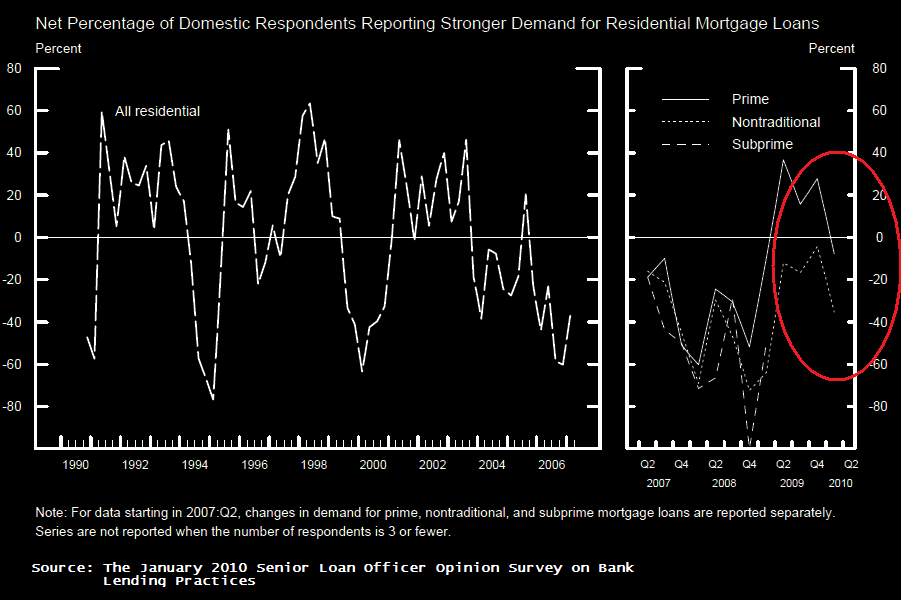
Bankers responding to the January 2010 Federal Reserve Senior Loan Officer Opinion Survey on Bank Lending Practices indicated that residential loan standards are still contracting. The report also states that consumer demand for mortgage loans continues to decline. 

The survey, released on Monday, addresses changes in loan supply and demand over the last three months.  It also included three sets of special questions about delinquency rates of loans made to large and middle market firms, changes in bank policies about commercial real estate (CRE) loans over the past year, and a third set of questions about the banks' outlook over the coming year for the credit quality of a number of categories of loans. 55 domestic banks and 23 U.S. branches and agencies of foreign banks responded to the questionnaire.

Banks continued to tighten standards on residential lending, especially on nontraditional residential real estate loans. 17 percent of banks that make residential loans reported they had tightened standards on prime real estate loans and 30 percent reported such tightening of non-traditional loans.


In addition, a moderate net fraction of banks reported weaker demand from prime borrowers for residential real estate loans. Demand from customers seeking nontraditional mortgages also weakened further over the survey period. Only a small net fraction of banks reported having tightened standards on revolving home equity lines of credit over the past three months, but a large net fraction of banks continued to report lower demand for such loans.

Demand for both businesses and households across all major categories of loans weakened on net over the past three months. 64 percent of respondents reported that business inquiries about new or increased credit had stayed about the same over the last three months while 13 percent reported an increase and 25 percent a decrease.

A large proportion of respondents reported that their banks were relatively unchanged in their approach to consumer lending.  Over 80 percent said that their banks policies were unchanged when it came to approving applications for installment, consumer, and credit card loans.  However, a substantial net fraction of banks said they had reduced credit limits on credit cards and had become less likely to issue cards to customers who do not meet credit scoring thresholds.  Respondents to the October 2009 survey had indicated that they would tighten many of their credit card policies as a reaction to passage of the Credit CARD Act.

Loan terms were seen as being a little more in flux but the net percentages of respondents who tightened those requirements was lower than in the previous quarter. When considering lending to large firms - those with annual sales of $50 million or more - 76 percent reported there had been no change in the maximum credit lines, 16 percent reported a tightening in the maximums and 7 percent said those terms had eased. Maximum maturity dates were unchanged in 83 percent of reports. Only 64 percent of respondents reported no change in the cost of credit lines while over 23 percent reported that these standards had tightened somewhat or considerably. Close to 26 percent reported that the spread charged to commercial borrowers had widened over the last three months compared to 58 percent that reported it unchanged. About 10 percent reported they had tightened collateral requirements, the remainder reported no change. Figures for lending to smaller companies varied only slightly from those reported for large firms.

Banks were also asked a special set of questions about asset quality. In contrast to responses in earlier surveys, substantially fewer respondents reported that they expected widespread deterioration in credit quality in the coming year. On the household side, a moderate net fraction of banks indicated that the credit quality of their prime residential mortgages and home equity loans would likely deteriorate further in 2010. However, banks expect portfolios of most other types of consumer and residential real estate loans to experience little further deterioration in credit quality this year—indeed, a moderate net share of banks expect some improvement in credit quality in other consumer loans.


Regards,
Jim Whatley
www.UberRealty.com
850.499.2940

Über
    Realty
Über service - less cost
(uber= superior, awesome)

Posted via email from uberrealty's posterous

Fannie Mae says it will cover the closing costs on purchases of its REO homes

Fannie Mae says it will cover the closing costs on purchases of its REO

 homes – an incentive the GSEhopes will help it pare down a bloated supply of repossessed foreclosed properties.

The nation’s largest mortgage financier has announced a temporary seller-assistance program under which people purchasing a property through HomePath, Fannie Mae’s REO disposition operation, will receive up to 3.5 percent of the final sales price, which can be applied toward closing costs or used to purchase appliances for their new home.

The offer is available to any owner-occupant who closes on the purchase of a property listed onHomePath.com before May 1, 2010, the company said. In addition, many Fannie

Mae-owned properties are eligible for special HomePath Mortgage and HomePath Renovation Mortgage financing, with as little as 3 percent down.

“Attracting qualified buyers to the market and reducing the inventory of vacant homes is critical to stabilizing neighborhoods and helping the market recover,” said Terry Edwards, EVP of credit portfolio management for Fannie Mae. “Many families are taking advantage of the federal homebuyer tax credit to buy a new home so this is a great time for Fannie Mae to offer some additional help.”

Recent data from Fannie Mae show an increase in the acquisition of foreclosed properties and an escalating rate of seriously delinquent loans, which means even larger volumes of REOs could be coming down the pipeline.

According to the GSE’s most recent quarterly filing, Fannie Mae acquired 98,428 homes through foreclosure during the first nine months of last year and sold 89,691 REO properties during the same period. But at the end of September, Fannie Mae still had 72,275 REO properties on its books, marking a 7 percent increase year-over-year.

Furthermore, Fannie Mae’s monthly summary shows significant growth in seriously delinquent single-family mortgages held or guaranteed by the company. Up from 2.13 percent in November 2008, loans three or more months behind in payments or in the foreclosure process soared to 5.29 percent in November 2009.

Regards,
Jim Whatley
UberRealty.com
850.499.2940

Über
    Realty
Über service - less cost
(uber= superior, awesome)

Posted via email from uberrealty's posterous

Saturday, January 30, 2010

DOM = DOA

Compared to most writers on Active Rain, (for writing skills),  I rate at the bottom of the rain barrel.
That doesn't mean my message is not  a good one. I grew up in the food business and that is where I learned about customer service.  The customer may not always be right,  but it is my job to serve them in the best way I can. I love to make people happy.  However, telling people that it is ok to put an unrealistic price on house is something I will not do.
Last week I was cutting a radio commercial and I started jawing with the DJ. (Woofy on 99 Rock). He had seen my car- the “Über Mobile” (which is another story) at our kids’ school. He told me that he  had just taken his house off the market after a year.  I saw him tense up a bit- not wanting to get get a sales pitch from me.  So I just asked- did you need to sell it? His reply was no. I said great, keep it off the market for now.  He went on to tell me about the short sales and foreclosures in his neighborhood.

In a declining market, Days on Market means "Dead On Active", (my new saying). What does “Dead-On-Active” mean?  Like dead-on-arrival, it means you have no chance of selling it. Your idea of what your home is worth and what someone is willing to pay for it are two different things. To me it means you are not reasonable and are not going to make a reasonable effort to sell your home at the market price. You are a lottery player.  Holding out for that one chance that someone will love it so much that they have to have it-  and will be willing to pay whatever price to own it.  (Experts say the Lottery is a tax on the stupid).  I believe most of those buyers are already gone.  I also told Woofy that I only want 90-day listings. Why? when the  average Day On Market is close to 180?  Because- I want to sell the home not just stick it in the MLS.  I put time into my listings;  I build my own signs, (if they want a  5', I'll do it), make my own flyers, stage the home (my wife helps), and check on my inventory at least once a week.  When I sell a home I meet everyone there. I meet with the home inspector,  the appraiser,  the pest inspector,  etc.  I'm always looking at who is doing what- and if they need help- I'm happy to jump in and do it.
What does this all mean? If I sign up to help someone who is unrealistic on price,  it takes my time away from someone I could actually help to sell their home. If after I show you the facts- and you still want to play the lottery- I can give you names of lots of guys who would gladly simply list your property. I'll call them for you.

Facts:
1. If you need to sell your home- do it. Don't “play like circus”.
2. Price it correctly- buyers know a lot more than you think they do.
3. If you do not need to sell- take it off the market.
4. Make sure it is in the best condition possible.

As I was writing this, I got a call from Bill Gates (not your Bill, mine), a customer if mine who wants to list his home. So now you can say you know Bill Gates' Realtor.
I as a Chef friend of mine you would say- gotta go-  kitchen's on fire.


homes for sale in fort walton beach, shalimar, navarre, destin, niceville, and crestview

Posted via email from uberrealty's posterous

Friday, January 29, 2010

RESPA Rule Delays Many Mortgages, Torpedoes Others

January 28, 2010
RESPA Rule Delays Many Mortgages, Torpedoes Others
By Kate Berry, American Banker
Confusion. Chaos. Pandemonium.
These are some of the words mortgage experts are using to describe the implementation of the home mortgage disclosure rule that took effect this month.
Loans are expected to take longer to close and many home purchases could be delayed or are falling through because lenders are being held to the good-faith estimate of closing costs they present to applicants.
Certain items such as the first month's interest paid in advance, title insurance premiums and state transfer taxes are posing particular problems. Technology glitches abound. Some lenders are adding quality-control and back-office personnel to review loan applications — particularly those submitted by mortgage brokers — that would automatically have been accepted before the rule took effect Jan. 1.
"It's just mass confusion," said Mary Kladde, the chief executive of Titan Lenders Corp., a Denver back-office fulfillment provider. "There just wasn't enough thought that went into the regulations before they were put into place."
Under the Real Estate Settlement Procedures Act rule, certain fees cannot be more than 10% higher in the settlement statement (known as the HUD-1) presented to the borrower at the closing table than they were in the good-faith estimate; otherwise the lender has to eat the difference.
Lenders and third-party settlement providers acknowledge they are listing the highest fees possible to avoid being penalized.
"Our only choice is to provide the highest costs available," said Don Casey, the president and CEO of Title Resource Group, a unit of Realogy Corp. of Parsippany, N.J. "The bigger national lenders want to be as conservative as possible and that's translating into higher costs. They're overestimating. Everybody is working out the bugs." (Realogy also owns the Century 21 and Coldwell Banker real estate brokerage franchises.)
Jonathan Kunkle, vice president of sales at LenderLive Network Inc., a Glendale, Colo., provider of mortgage outsourcing services, said the new RESPA rule is affecting "every facet of lending," because the ultimate investor purchasing a loan must review the application.
"It delays warehouse lines, turn times and overall lending capacity for a correspondent — everything gets put on hold," Kunkle said. "Worse, if the loan wasn't done correctly under RESPA, it becomes unsaleable."
The biggest impact is being felt by wholesale lenders, experts said.
Andrew WeissMalik, a vice president at 360 Mortgage Group LLC, an Austin wholesale lender, said many brokers are turning in applications filled out incorrectly.
"When it comes to RESPA, they either get it or they don't," he said. "The hard part for uneducated brokers is completing the entire package."
Some brokers will leave third-party service provider lists blank, refuse to fill in dates and put down recording fees for the wrong county, he said.
Technically, a good-faith estimate with such errors would mean "that the deal is dead," but more often than not a broker will issue a new good-faith estimate to the borrower and submit the loan application to another lender.
"Under RESPA, the broker should decline the application or pay for the difference" between estimated and actual fees, WeissMalik said. Instead, "if one lender turns the loan down, the broker will repackage it and make the deal work somewhere else," in violation of the law.
Jonathan Corr, the chief strategy officer at Ellie Mae Inc., an origination software vendor, said closing a loan will take longer than the usual 30 to 45 days.
"Borrowers have to be prepared for a longer process than what they're used to, because people are learning on the job," he said.
Don Covey, managing director of origination technology at Lender Processing Services Inc. in Jacksonville, Fla., said lenders also are asking vendors like his to create filters so they can review applications from brokers before processing them.
"The battle in the marketplace right now is when did they accept the loan: when it hit my technology or after I had a chance to review and accept it?" Covey said.
"All the lenders right now are checking what has been disclosed and are screening files, because they could start losing real money," he said.
Kladde said she expects the new disclosure rule will result in 25% fewer loans being closed, at least in the short term.
Some of the problems are the result of the Department of Housing and Urban Development's attempt to simplify fees for borrowers by lumping them together instead of itemizing them, she said.
Certain states also have their own restrictions.
For example, New Jersey does not allow lenders to charge a "processing fee," so lenders typically make up another fee and charge that, Kladde said. On one loan application, a closing attorney charged an "Urgency of the moment fee." "They just made it up," Kladde said, with a chuckle.
"It's going to be really bad for the first three months," she said.
Many lenders and third-party settlement providers said they agreed with the intent of the new disclosure rule, which was to lower costs for borrowers and increase competition for the various fees associated with a home purchase. But they questioned whether it will work as well as intended.
"There will be transparency, but from a cost perspective you worry that some of these higher costs will ultimately stick to the consumer," Casey said.
— Kate Berry is a reporter for American Banker.

Posted via email from uberrealty's posterous

Monday, January 25, 2010

Prices Fall in 16 of 20 Major Housing Markets

Prices Fall in 16 of 20 Major Housing Markets
by PAUL JACKSON
Thursday, January 10th, 2008, 3:20 pm

Prices of properties listed for sale continued to fall in December, dropping in 16 of 20 major markets, while West Coast cities lead the charge.

According to a report from real estate research firms Altos Research and Real IQ, released late Wednesday, San Francisco saw average home prices drop 4.6 percent during the past three months, while Las Vegas, San Diego, Los Angeles and Detroit all registered price declines of over 3 percent.

Prices remained flat in two markets — Dallas, with a +0.1 percent gain over three months, and Phoenix, with a -0.1 percent loss — while three additional markets (Charlotte, New York, and Washington, DC) were not included in the price index for December due to a revision in data collection methodology.

The largest single-month declines occurred in San Francisco and San Diego, with prices dropping 2.6 percent and 2.1 percent between November and December.

Listing inventories decline, while DOM jumps
Time on market continued to increase in nearly every market tracked in the report, with Miami reporting the longest days-on-market (DOM) at 143 in December; Minneapolis and Detroit both registered 136 days on market. Portland has seen DOM increase by 48.2 percent over the course of three months, reaching 99 days in December.

Click here to see the full report.


“Sellers continue to adjust their price expectations downward but not quickly enough to keep pace with declining demand,� said Stephen Bedikian, partner and research director for Real IQ. “Until we see declines in both inventory levels and days-on-market, we won’t have any confidence that supply and demand are balancing out.�

As DOM jumped, listing inventories declined in most markets — with the exception of key markets in Florida, Tampa and Miami, which posted inventory increases of 10.5 percent and 4.0 percent respectively.

“Declining inventory levels are essential to a recovery in the housing market,� said Michael Simonsen, CEO and co-founder of Altos Research.

“However, if the economy continues to slow or enters a recession, we may see inventories balloon again in the Spring and downward pricing pressure on sellers will intensify.�

Posted via email from uberrealty's posterous